Is your schedule as crazy as mine? For some reason this year seems a lot more nuts-o than usual. Maybe it's because the teachers' schedules are pretty overwhelming as well. I'm still trying to work out kinks and it's already the third week of school for me.
I thought I'd help some of the teachers out (and me too) by giving them some reminder cards. This way they know exactly when the kids in their classrooms have speech.
I also do lots of inclusion/push-in with my students, so I wanted to remind teachers when I'll be coming into their classrooms to work with kiddos too. These signs are perfect to hang up near their desks or on their bulletin boards. Hopefully, this will help them remember to stick to their schedule/plan on those days.
You can grab these reminder cards for free HERE! Hope you can use them! Let me know what you think and please leave a comment below if you download. :)
Graphics by The 3am Teacher
I hope you've enjoyed freebie week on the blog! Be sure and check back tomorrow for some MAJOR fun and surprises!!! :)
Showing posts with label Inclusion. Show all posts
Thursday, August 29, 2013
Friday, March 29, 2013
FAQ Friday: Off-topic Answers
It's FAQ Friday time! Don't forget to send me your questions! I'd love to be able to help you dig a little and find some good answers. :)
Today's question is brought to you by a couple of teachers that I work with. I love it when they ask me how they can help the students with language disorders. It shows that they really care about the student's learning and they value my opinions as an SLP. Here's what they asked me recently:
Our conversations usually go something like this:
-Teacher: Many of your students give "off the wall" responses to the questions that I ask them, what do you do with that? Are there any strategies or things that I can do while teaching that would help them?
-Me: Can you give me an example?
-Teacher: Sure. I asked, "How long did the king reign over his kingdom?" And the student responded, "Sometimes thunder is loud, and you can't play outside when it's raining."
I procede to explain to the teachers that off-topic responses are usually an indication of a receptive language disorder, meaning they aren't correctly processing the information being asked of them. The students I work with also often have a very limited vocabulary. In the example, this student had never heard the word "reign" and related it back to the only word he knew "rain." On top of that, his language is still very ego-centric, and it is very difficult for him to think outside of his own experiences.
I attempt to give teachers a few strategies to try out in the classrooms with my language-disordered students, along with the disclaimer that every child is different, and what works with one may not work with another.
Here are a few:
Today's question is brought to you by a couple of teachers that I work with. I love it when they ask me how they can help the students with language disorders. It shows that they really care about the student's learning and they value my opinions as an SLP. Here's what they asked me recently:
Our conversations usually go something like this:
-Teacher: Many of your students give "off the wall" responses to the questions that I ask them, what do you do with that? Are there any strategies or things that I can do while teaching that would help them?
-Me: Can you give me an example?
-Teacher: Sure. I asked, "How long did the king reign over his kingdom?" And the student responded, "Sometimes thunder is loud, and you can't play outside when it's raining."
I procede to explain to the teachers that off-topic responses are usually an indication of a receptive language disorder, meaning they aren't correctly processing the information being asked of them. The students I work with also often have a very limited vocabulary. In the example, this student had never heard the word "reign" and related it back to the only word he knew "rain." On top of that, his language is still very ego-centric, and it is very difficult for him to think outside of his own experiences.
I attempt to give teachers a few strategies to try out in the classrooms with my language-disordered students, along with the disclaimer that every child is different, and what works with one may not work with another.
Here are a few:
- Anticipate that the child may not process the question correctly. Rephrase the question using simpler vocabulary.
- Give the student time to process the question and encourage him to think about what is being asked before immediately responding.
- Give the child a choice between 2 possible answers.
- Give visual cues by pointing, highlighting key words, drawing a picture, etc.
- Try not to just move on to the next student when they respond incorrectly. Scaffold down or break down the question until they can come up with the answer.
- Explain words with multiple or hidden meanings.
- Make the question a yes/no question if necessary.
- If nothing seems to be working, encourage him to ask a friend for help. Let him practice asking the question to someone else in his own words. Sometimes just this act will help him internalize the question.
What other tips do you have? I'd love to hear how some of you respond to questions like this from teachers.
I previously did a post on tips for teachers that included a freebie handout. You can refer to that post if you need something tangible to give to teachers.
Friday, January 11, 2013
Tips for Teachers
Many of the teachers I work with often ask for tips or strategies that they can do in the classroom to help their language disordered students. I always respond with a hearty "Absolutely!" It makes me happy when teachers respect me and my profession enough to ask for my thoughts about something.
Now, obviously each child is different, and every strategy may not work for all. However, I do have a "tip sheet" that I give to my teachers as general strategies they can use. It's mostly to give teachers a starting point and some ideas to try, in case they aren't already doing them. I'm in the process of developing some more in depth tip sheets broken down by different disorders.
In the mean time, I'll just stick with this handout. Here is what it looks like:
Maybe your teachers can use this too. You can grab it for free HERE. Please leave a comment if you download! :)
Happy Friday, everyone!
Monday, December 17, 2012
The Three Snow Bears Speech & Language Packet
After using some awesome story companions from a few of my very talented bloggy friends, I forgot how much I really loved incorporating literature themes into my sessions. I do it all the time with my preschoolers. Because I do inclusion for language in my older grades, I rarely get the chance to use it with my language groups.
With the variety that some of these packets offer, I was able to easily adapt them for the classroom. Anyway, I thought I'd take a stab at it myself, mostly so that I could have the variety of targets I needed to address different classes and grade levels. One of my favorite Jan Brett books is The Three Snow Bears. It's kind of like a arctic version of Goldilocks and the Three Bears. My kids of all ages love it!
Check out this 34 page packet!
I'm so excited about it! Let's dig in a little, shall we?
- Story props - I use these for an added visual while reading the story, as well as to help with story retell. They love playing with them and acting out the different scenes.
- Sequencing cards - Put the cards in order the events occurred in the story. You can also use these for retell.
- Vocabulary cards - 8 simple pictures for describing, identifying, or defining
- Vocabulary synonym matching - A little higher level. You can use the context clues to figure out what the word means and then find the matching synonym. Play it like memory.
- Comprehension questions - 16 comprehension questions with visuals
- Predicting chart - This chart can be completed as you read the story. I plan on bringing this in the classroom when they address this skill and doing it together.
- Summarizing organizer - Summarize the main events in the story by using this graphic organizer.
- Compare & contrast organizer - This lets you find the similarities and differences between this story and the original Goldilocks and the 3 Bears. I also plan on doing this one whole group.
- Inferencing chart - My fourth and fifth graders have to be able to come up with their own inferences. This chart will help them understand how they got their inference and what each part means.
- Feelings inferences - As you read the story, infer how each character might be feeling. Match the thought bubbles to the cards.
- Good & bad manners sort - Talk about what is and isn't appropriate by sorting igloos onto the ice mats.
- Game board - This is an open-ended game board to be used with the enclosed cards or any card deck you choose.
- Articulation cards for /r/, /s/, /l/
- Regular plural cards
- Regular and irregular past tense cards
- Game board wild cards
What do you think? I definitely needed something that could be used with many different skills, and thought perhaps you might need that too.
You can grab this packet at my TPT store HERE!
Enjoy :)
PS I'll give a free copy to the first two blog followers that comment with their email. To become a follower, just click the "join this site" button on the side.
Monday, December 3, 2012
Too Many Tamales Sequencing & More
Have any of you read the book Too Many Tamales
by Gary Soto? It's such a cute book to read with your kiddos. I usually communicatively read through it with my 2nd - 5th graders to work on those higher level language targets.
Here's why I <3 this book:
- It's great to show how another culture celebrates Christmas. I like to get my hispanic students to explain to the other kids what tamales are and how they celebrate Christmas with their family.
- A variety of skills can be targeted when reading through it. It's perfect for sequencing, inferencing, predicting, and cause/effect.
- You see many different emotions in it - happy, excited, shame, sadness, shock, etc. Love this for my pragmatic kids.
- The illustrations are clear and expressive.
- It provides opportunity for lots of new vocabulary.
Today, my 3rd graders were working on sequencing. I saw {this} post on pinterest last year and made my own sequencing road out of bulletin board paper. Here's how it turned out:
The kids had so much fun with this. While we read the story, I asked inferencing/predicting questions and had the kids write down words with their articulation sounds in them.
Then, we sequenced the story using the road.
I then had them go back and discuss the story elements. They loved being able to get up and move around. It was a lot more motivating for them.
Cute, right? I made a packet to accompany Too Many Tamales that includes some graphic organizers for predicting and cause/effect as well as inferencing questions with answers. There is also the "I can find my speech sound" tamale worksheets. HERE is the link to the freebie!
What else could you do with a sequencing road OR the book Too Many Tamales??
Friday, November 30, 2012
Cause and Effect Arcade
I'm taking a little break from the fun Christmas activities (by "little" I mean tiny!) to do a cause and effect game for my 4th graders. I needed some type of game that I could bring into the classroom, but that also would give them a variety of practice.
To make it a little more motivating for them, it's arcade-themed! I'm loving these graphics. :)
Kids move across a game board of tickets by rolling the dice and answering the questions on the cards.
Their cause and effect skills are targeted by 3 types of question cards:
1. Ball pit cards - students identify whether the underlined portion of the sentence is the cause or the effect.
2. Skee-ball cards - students answer a cause or effect question about a paragraph.
3. Toy claw cards - students come up with their own cause or effect for a situation.
The game also has wild cards, blank cards, an answer key, and cause/effect strategy cards with key words.
Grab this at my TPT store HERE! Enjoy!! :)
Clipart by: JWIllustrations
To make it a little more motivating for them, it's arcade-themed! I'm loving these graphics. :)
Kids move across a game board of tickets by rolling the dice and answering the questions on the cards.
Their cause and effect skills are targeted by 3 types of question cards:
1. Ball pit cards - students identify whether the underlined portion of the sentence is the cause or the effect.
2. Skee-ball cards - students answer a cause or effect question about a paragraph.
3. Toy claw cards - students come up with their own cause or effect for a situation.
The game also has wild cards, blank cards, an answer key, and cause/effect strategy cards with key words.
Grab this at my TPT store HERE! Enjoy!! :)
Clipart by: JWIllustrations
Monday, November 19, 2012
Adjetivos Remix App Review
It's been so exciting to see all the fun holiday freebie posts! Thanks to everyone who has linked up so far! :)
Today, I'm reviewing a Spanish app! Smarty ears was awesome and donated a copy of Adjetivos Remix for me to review; however, all of the opinions in this post are my own.
I used this app all last week with my hispanic kiddos, and they loved it. Even my non Spanish-speakers wanted to give it a try. lol
Ok, so Adjetivos Remix is an app that targets the use of a variety of adjectives and concepts in Spanish. It uses questions and pictures as stimuli. Students identify the appropriate picture that depicts the adjective in the question.
Here is the menu page. Note that it's all in Spanish. There is a quick start option at the lower left-hand corner. This will take you immediately to the questions.
In the examples above, the questions ask students "which is heavy?" and "which is hot?" and students must touch the correct picture. You can also "select students" instead of pressing quick start and save the data to the appropriate child. There is a place for you to add a pic or avatar of the child as well.
It keeps track of each students data for you, so that you are able to email yourself the results.
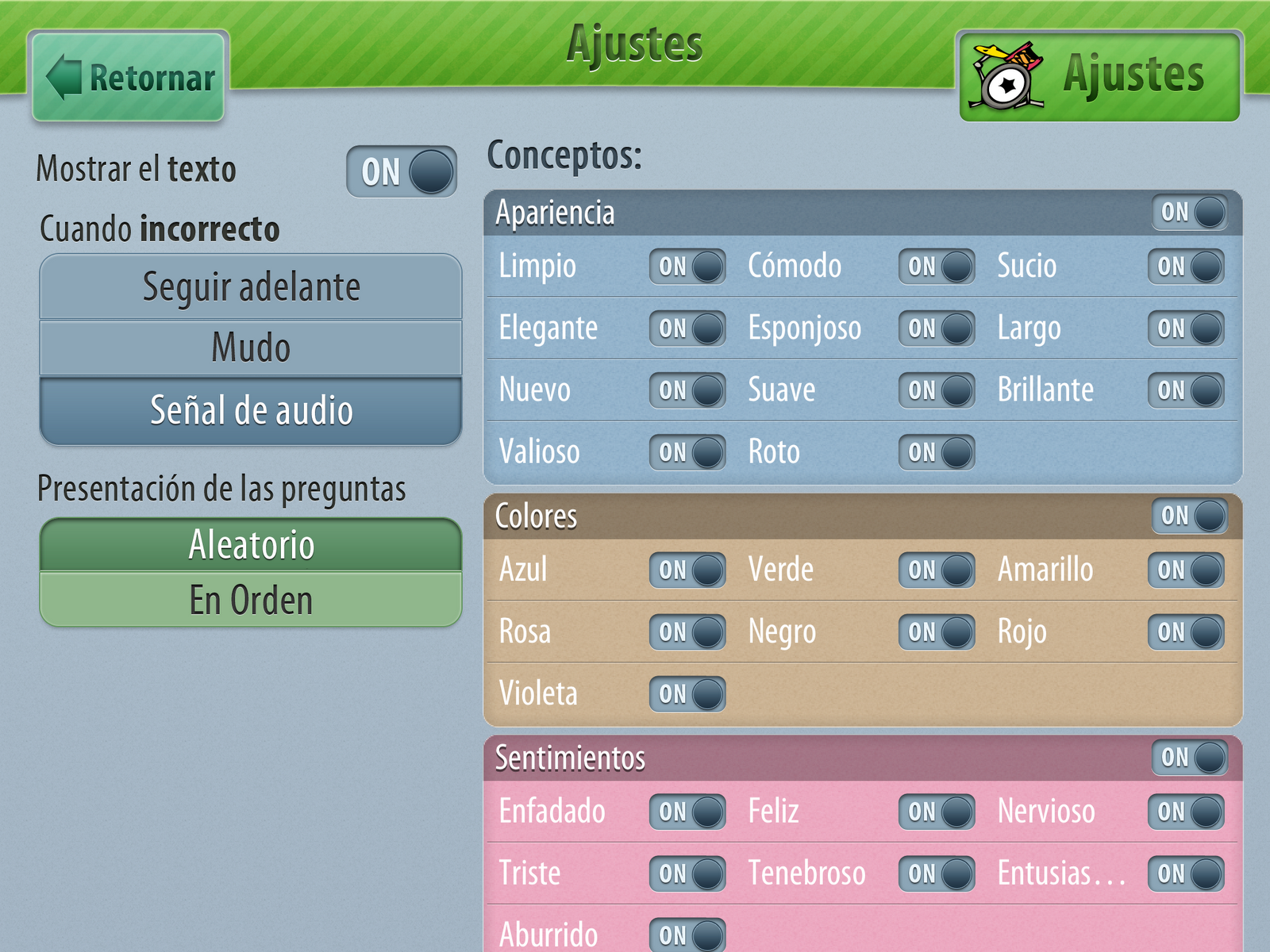
One of the awesome things about this app (and most smarty ears apps, for that matter) is the ability to customize! Check out the settings page below.
You can pick and choose the exact types of "adjetivos" that you want to target. The categories included are: appearance, colors, feelings, quantity, shape, size, time, and touch/taste. You can choose to turn an entire category off/on or individual adjectives. You can also decide whether you want to show the text, randomize the questions, and decide what you want to happen for incorrect answers.
You can grab this app from iTunes for $9.99 but it's on sale right now for $4.99! Check it out HERE!
*There is also an English version available! Check that one out HERE on sale for $5.99!
Overall, this is an excellent app. One thing that might make it even better would be maybe adding an option for more than two choices. Right now kids have a 50/50 shot of getting it right.
Having apps like this are great for inclusion to take into the classroom!
Thursday, November 1, 2012
Reading Rockets
I don't know about you, but it seems like several of my little guys struggle with reading. Many of them break down with the simplest of words. The more I probe I realize that they don't have the basic phonological awareness skills needed to become successful readers. Now, I know there are exceptions and some kids learn by memorizing sight words. For the most part, I find that teaching kids these skills is VERY beneficial for their early reading skills.
I developed THIS phonological awareness game to help target these goals in therapy. It's called Reading Rockets. Check it out!
To play, the students take turns drawing cards and following the directions. If they answer correctly, they get to keep the card. If they answer incorrectly, another student gets a try. They can keep their cards on these cutesie planet mats.
And watch out for the wild cards! If they draw one they were lost in space or captured by aliens and have to put all their cards back. The student with the most cards at the end is the winner.
The game includes 72 rocket cards that target rhyming, beginning sounds, middle sounds, ending sounds, counting sounds in words, and blending sounds to read words.
Hope this helps some of you!! It's ready and available at my TPT Store right now.
Graphics are by craftygraphicsscraps.
So how do you work on reading skills with your kids? What do your goals look like?
Thursday, October 18, 2012
Angry Birds Teach Main Idea: Lesson & Game!
Ok, I am all about keeping my students motivated to learn new concepts. Sometimes it feels like the only way to keep their attention is to sing and dance and stand on your head...and then that only works once. Haha. I've also found that using things that are interesting to them is a very helpful tool to keep them engaged.
Three lose a turn cards and three extra turn
cards.
So, what are all my kids interested in right now? Angry Birds!! They love this game. Every time I get out my iPad they ask me to play it. I guess I can't blame them...it is a really fun game. I knew I needed to find a way to incorporate Angry Birds into my classroom therapy.
This week, several of my grade levels are working on finding the main idea of a passage. So, I created a lesson using Angry Birds to co-teach the concept of main idea with the classroom teacher. Check it out. :)
The first slide is their learning target or "I can" statement. This helps the kids to know what they will be able to do once we are finished.
This lesson has fun definitions, tips, and 5 examples that have to do with angry birds. The examples start out easy and get more complex.
You can save this lesson in iBooks and view it as an ebook or display it on your regular computer or projector. This definitely makes it easy for me to modify for the classroom.
I also made a freebie game to go along with the lesson. This game uses 18 angry bird story cards. The kids have to try and come up with their own main idea of the passages.
But watch out for the pigs! There are 6 green pig cards. Three lose a turn cards and three extra turn
cards.
Unfortunately, I decided to remove access to this lesson and game because of copyright. I just didn't want to get in trouble! Lol. If you have any questions you can email me at busybeespeech@gmail.com. :)
Subscribe to:
Posts (Atom)