Tuesday, July 9, 2013

Therapy Organization Planners & Binders

So I am totally one of those people with great organizational ambitions.  At the beginning of the school year everything is nice and neat and organized.  As the year moves along, piles begin to form and papers begin to stack up.  I look around and things are a little out of place  aren't so organized anymore  pretty much a wreck.

This year I'll be trying out some new systems, so I'm hoping that they'll stick...especially since I found out that I'm now going to be the only SLP at my school.  Yes, I work at a primary school.  No, I have no idea how I'm going to manage.  Any advice is welcome and appreciated lol.  I figure I'm going to have to be super organized to make it work.

In my attempt to coral my paperwork, I'll be keeping a therapy binder or 2.  I combined a couple of great downloads I found on TPT to make my binder.  I used the Let's Get Organized packet from [simply speech] and the 2013-2014 SLP Monthly Planner from Denise Polley.


Both packs have such cute pages!  I just printed out the ones that applied to me and tweaked a couple of them a little with my sharpie to meet my needs.  :)
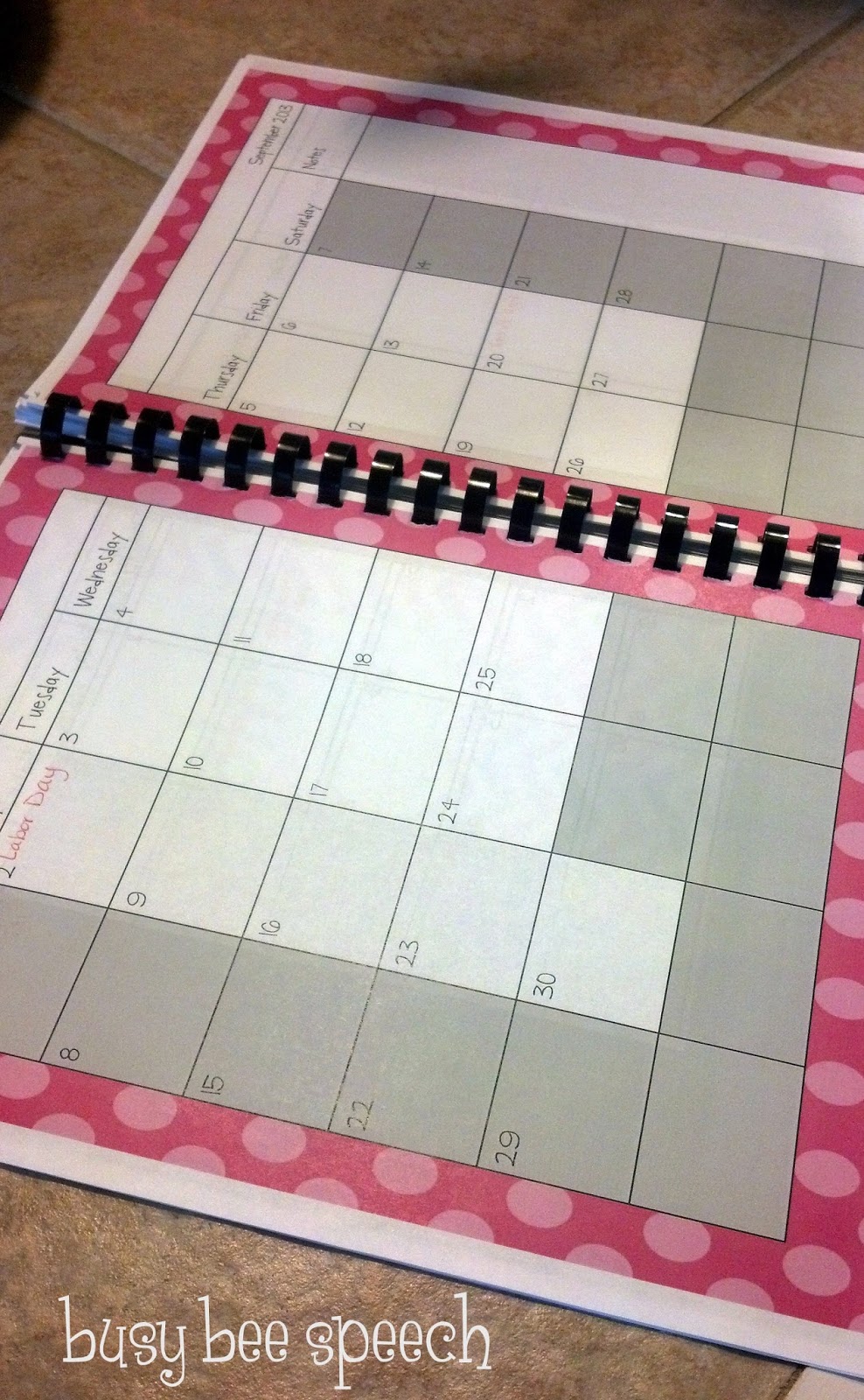

I'm thinking that this will be just what I need.  I've got a calendar for each month, referral info, and screening and RtI info.


I even included a copy of my district's procedure checklists for quick reference.


There are also sections for evals, re-evals, due dates, medicaid lists, running to-do lists, parent contact info, and more.  I spiral-bound it all together, so it's not as bulky as an actual binder.  It's more like a planner.

**UPDATE:  I recently created my own planner to customize it to fit more of my needs.  You can check it out HERE!

I do have another binder where I keep all my student data and attendance information.


I section it off by grade and store their lesson plans, tally sheets, and medicaid logs behind each tab.  Because these have to be filed every 9 weeks, they need to be in a place where I can transfer them easily.


I'm also thinking about keeping all of their therapy data on the Therapy Report Center app by Smarty Ears.  I'm still trying to work out the logistics of it.

How do you keep your paperwork organized?  Any tips you can share?

Monday, July 8, 2013

Bloglovin and a Pretty New Design!

Are you on Bloglovin?  I'm really liking it to keep up with my blog reading, and the iPad app is very easy to use.  You can stay up to date with all of my posts and products by following me there.  Just click on the yellow (+) button at the top right corner of my page.

OR click the button below:

Follow on Bloglovin


Speaking of buttons, I've got lots of pretty new buttons on my newly designed blog page!  Isn't it pretty?  I'm loving it so far!  A big thanks to Tessa from Tales From A Blogdesigner for helping me with a mini makeover!  :)

I also added some custom categories to my TPT store to make it easier to browse through products.  You can find them near the top of the left hand column of my store.


Just wanted to fill you in on the news!  Thanks so much for reading.  It means more than you know! :)

Friday, July 5, 2013

FAQ Friday: Baby Talk

Hooray for Friday!  Hope you had a happy holiday yesterday and that some of you are enjoying a nice, long weekend.  Here's a new FAQ Friday post to get your weekend started!


Today's question is brought to you some of my friends who are new moms with cute little babies.  :)  They want to know if it's ok to speak "baby talk" to their kids.


Sometimes baby talk is referred to as "motherese" or "parentese," and this kind of talk is perfectly normal and actually pretty beneficial for your young kiddos.  These types of sentences are usually simple and short, with repeated words and elongated vowels.  When speaking, parents often use slow rates and higher pitches with happy facial expressions.  For example, "Do you see the car?  That's a big big car.  Cars go fast!  Vroom!"

Check out what this speech pathologist from The Hanen Center writes about baby talk:

{Source}

However, you do want to make sure you are modeling grammatically correct speech and correct articulation.  Be careful not to drop off ends of words, like -ing or -s, to shorten the sentences.  It's important for kids to develop a good sense of grammar and word meanings.

As kids get older, some go through stages of developmental misarticulations.  Adults might think it's "cute" and may speak back to them using those same errors.  And sometimes what a child says IS funny AND cute!  It's ok to talk and laugh about it.  You just want to be sure and model correct articulation when speaking to them, as not to reinforce their errors.

What are your thoughts?  I'd love to hear your opinions!  :)

Thursday, July 4, 2013

Celebrating with a Sale!

Happy 4th of July!  Wishing you a day full of fun, fireworks, flags, food, and family!! {I'm getting good at this alliteration thing ;)}

To help celebrate America I'm throwing a TPT sale!  So organize those wishlists and grab what you need, because everything is 20% off today.


I go back to work on August 5th, so I'll be filling my cart with materials I can use for next year.  If you're looking for any, my 2 new products, Candy Math Word Problems and Carry Over Activities for Articulation, will both be 20% off as well.  You can find my TPT store HERE!

Have a great Fourth!  :)

Wednesday, July 3, 2013

Candy Math Word Problems for Language Disorders

A few months ago, I was assigned to administer our state test to a small group of fourth graders.  For the most part, they were troopers and hung in there during a week of long and tedious testing.

What surprised me, though, was where they became the most frustrated.  It wasn't during reading comprehension or proofreading; it was during math word problems!  They would sigh and raise their hands for help and try to ask me questions.  I felt really sad that I couldn't help them.  They know me as the lady who gives them strategies, breaks things down, explains difficult words.  All I could do was say, "I'm sorry, I can't help you."

I decided that day that I needed to make a math product.  Something that I could use to teach the kids how to break down and understand math word problems.  There is a TON of language and vocabulary involved in math, and I know that half their battle was reading comprehension.

According to THIS article, addressing the language of math is well within the SLP's scope of practice.  Here are a few other articles that show the importance of an SLP supporting students in math:


I am so very excited to show you this new product!  Check out Candy Math Word Problems for Language Disorders!  It's based on Common Core State Standards and geared toward kids in grades 2-5.


There's a strategy cards with visuals to help kids maneuver through the problems.  I've also included some math operations key word cards.  This will help kids know which operation to (often) use when they see certain words. 

 I do explain to them, though, that not all problems are black and white, and you have to be able to understand the problem to make sure you are using the correct steps.

What's a speechie game without a super cute and colorful game board?  :)


I've also included math terminology gumdrops.  Match the word to the definition to help students understand math vocab.


There are 18 word problem comprehension cards for each grade (2-5).  Four questions are addressed on  each card: 1. What happened in the story?  2. What key words do you see?  3. What do you need to find out?  4.  How can you solve this problem?


I want my students to think about these questions whenever they go to answer a word problem in class. My LD kids need to practice breaking down the questions and implementing strategies.


The cards for each grade are color-coded for easy storage and use.  Since some of us SLPs don't consider ourselves to be "math people," I tried to go with the standards that could be easily checked with a calculator.


Of course, I included an answer key.  This is math after all.  ;)


You can grab this product at my TPT store HERE!

What do you think?  Do your kids struggle in math because of their language disorder too?


Friday, June 28, 2013

FAQ Friday: Thumb Sucking

FAQ Friday is back!  Hooray!  In case you aren't so familiar with it, I try to take a question I commonly get asked and give you some good researched information about it.  Though I certainly do not claim to have all the answers, I'll dig/research/ask other professionals and give you my 2 cents about the topics! :)


Today's question is brought to you by my friends with toddlers and young kids.  They want to know if thumb-sucking is ok or if it has harmful effects on their kid's speech.


The short answer: it can be.

First of all, let me just say that most thumb-sucking is normal.  Babies can even begin sucking their thumbs in the womb.  As infants, thumbs and pacifiers can be great soothing mechanisms.

The problem comes in when kids keep sucking their thumbs or pacifiers as their teeth and jaws begin to develop, usually passed the age of 2.  Thumb-sucking can actually have the potential of causing oral musculature and formation problems.  It can cause incorrect tongue placement and the teeth to form into an open-bite.

My baby sister is a prime example of this.  She sucked her thumb until the age of 5, causing a severe open bite and articulation deficits.  Thankfully, her teeth are perfect now, and she can speak just fine.  ;)  Here she is back in the day in all her open-bite glory lol (Love ya, Ash!).


When children suck their thumbs, it can affect the position and movements of their tongues, causing it to thrust too far forward or have weak muscle control during speech.  The most common sounds that can be affected by incorrect tongue placement are the alveolar sounds: /s, z, t, d, n, l/.  Other speech sounds can also be affected.  Open bites and tongue thrusts are often a perfect recipe for a frontal lisp.

When a child comes in with an open bite and interdental placement of alveolar sounds, it's usually a long hard road to normalcy during speech therapy.  I know some therapists that may not even choose to work with a child who has an open bite.  They would prefer to wait until it closes or refer to a dentist.

Overall, if your child is around the age of 2 and still sucking on his thumb or a pacifier, I'd say you might try working to stop it before it negatively affects them.

Here are several other articles and sites that deal with thumb-sucking and speech problems.  Be sure and check them out:

Wednesday, June 26, 2013

Firework Artic FREEBIE!

I can't believe it's the end of June already!  Now that my weddings and showers are over, it's about that time to iron out the plans for the Fourth.  Man, I LOVE summer!

For those of you doing some private therapy during the summer, here's a cute freebie to get your kids excited about Independence Day!  Check out Firework Artic for K, G, F!


Most kids love fireworks, so this product will give you an opportunity to talk about fireworks, safety, and of course practice their sounds.


Use the included game board to move pieces from start to finish.  They can turn over one of their artic cards before each turn.  It's open-ended, so feel free to use your other card decks or materials alongside it!


There are 18 cards with visuals for each sound: K, G, F in all positions.  


This game can also be played without the game board in a Memory-matching style.  


I've also included a blank card sheet for you to add your own sounds!  Thanks so much for your support of my little blog!  This freebie is just my way of saying thanks.  You can grab this game from my TPT store HERE!  And don't forget to follow me while you're there.  :)
Related Posts Plugin for WordPress, Blogger...